Order with confidence
Navigating European seafood menus requires decoding billing by weight, biological seasonality, and ancient table conventions.
The Anatomy of Weight-Based Billing (Al Kilo / S/M)
In authentic seafood houses across Spain, Italy, Portugal, and Greece, whole premium fish and live crustaceans are never priced at a fixed single-portion rate. Menus will display S/M (según mercado / selon marché) or list a rate per kilogram (e.g., €75 / kg) or per 100 grams.
A knowledgeable diner never orders blindly from text alone. The standard protocol involves visiting the display counter or welcoming the server who brings the raw whole specimen on an oval tray to your table. You assess the fish, ask for the weighed mass, and confirm the final price before it enters the kitchen or meets the embers. This is not viewed as distrust, but as a mutual sign of connoisseurship.
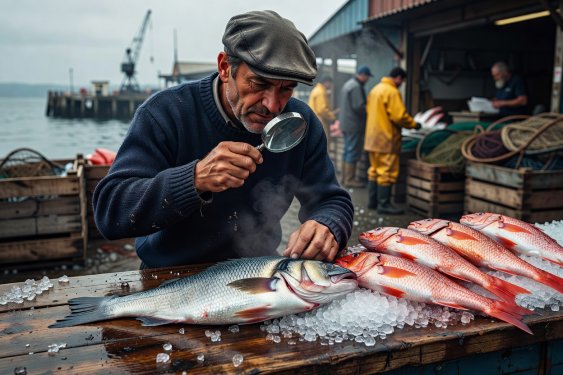
Reading Freshness at the Ice Display
Cornea: Eyes must be bulged, convex, and crystal clear; never sunken, cloudy, or milky.
Gills: Lift the operculum. Gills must be bright blood-red or deep carmine, moist and clean without sticky grey slime.
Flesh Rigor: Press gently; muscle flesh must be rigid and bounce back instantly without indentation.
Scent: The fish must smell exclusively of cold oceanic brine, wet rocks, and fresh kelp, never of ammonia or pungent sulfur.
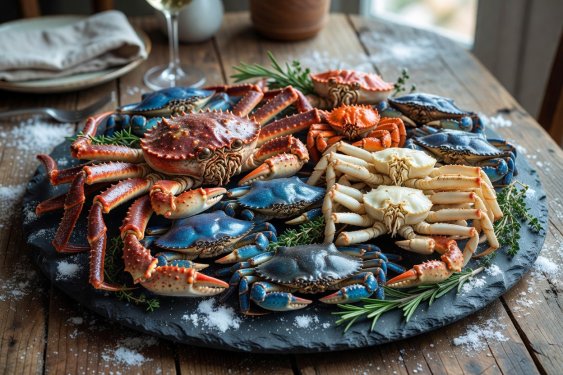
The Rule of the 'R' and Shellfish Biology
The historical adage to eat native oysters only in months containing an "R" (September through April) stems from reproductive biology. During warm summer months, bivalves expend energy on reproduction, turning milky and soft while water temperatures foster algal blooms.
Conversely, cold winter waters maximize crustacean fat, glycogen density, and muscular tightness, making autumn and winter the golden season for European crabs, lobsters, and barnacles.
Crucial European Table Protocols
- Never Ask for Grated Cheese on Seafood in Italy
- Adding Parmigiano or Grana Padano to seafood pasta (such as Spaghetti alle Vongole) is considered a severe culinary breach in Italy. The rich umami fats of hard cheese mask the delicate iodine of fresh clams and prawns.
- Embrace the Head and Bone Anatomy
- In Basque, Galician, and Mediterranean homes, true flavor is understood to concentrate in the collar (kokotxas), gelatinous cheeks, and head fat. Sucking the head juices of red carabineros or Langoustines is customary and celebrated as the highest culinary pleasure.
- The 'Couvert' in Portugal
- In Portuguese marisqueiras, servers automatically set down bread, butter, sheep's cheese, and marinated olives. These are not complimentary; you are billed only for what you consume. If you do not wish to partake, leave them untouched.
Ordering Matrix: Portion & Pairing Archetypes
| Catch Format | Target Sizing for Two Diners | Traditional Culinary Treatment | Standard Regional Wine Pairing |
|---|---|---|---|
| Whole Turbot (Rodaballo) | 1.0 kg – 1.4 kg (whole on bone) | Charcoal grill in wire parilla, splash of txakoli vinegar | Getariako Txakolina (Basque) |
| Spider Crab (Centollo) | 1.2 kg – 1.6 kg (live weight) | Boiled in sea salt, roe emulsion in head carapace | Albariño Rías Baixas (Galicia) |
| Bouillabaisse Service | Full multi-course feast | Saffron rockfish broth first, followed by carved carcasses | Cassis Blanc or Bandol Rosé (Provence) |
| Plateau Royal | 1 platter (12 oysters, crabs, prawns) | Chilled raw on ice with seaweed, rye, salted butter | Muscadet Sèvre et Maine sur Lie (Loire) |